The National Jewish Assembly (NJA) has taken note of recent reporting concerning Sam Mézec, leader of Reform Jersey, Jersey’s current Minister for Housing and a candidate for Senator, and Lee Carpenter, a board member of Reform Jersey and candidate for Deputy in St Helier Central.
This has prompted a closer examination of publicly available material and the questions it raises concerning standards of public discourse, judgment and accountability.
For the avoidance of doubt, Reform Jersey is a Jersey political party and has no connection to Reform UK. The focus of this statement is solely on the public conduct, statements and associations of the individuals referred to above.
Some may ask why the NJA is commenting on statements made by public figures in Jersey.
The answer is straightforward. The National Jewish Assembly exists to promote Jewish life, support Israel as the nation state of the Jewish people, and combat antisemitism. When public figures make statements concerning Israel, Zionism and matters that resonate deeply within Jewish communities, it is entirely appropriate that those statements are subjected to scrutiny.
That is particularly so in Jersey, a self-governing Crown Dependency with close constitutional, historical and cultural ties to the United Kingdom. While the National Jewish Assembly does not ordinarily comment on figures outside of the UK, Jersey occupies a unique place within the British Isles, the British family of nations, and institutions. The issues raised by the statements discussed in this paper are therefore not matters in which the National Jewish Assembly considers itself a disinterested observer.
Experience has repeatedly shown that hostility directed towards Israel often does not remain confined to Israel. Periods of conflict in the Middle East are frequently accompanied by sharp increases in antisemitic incidents directed at Jewish communities around the world, irrespective of their personal involvement in, responsibility for, or ability to influence events in the region. For that reason, questions concerning public discourse, standards of conduct and attitudes towards Israel and Jewish communities are matters of wider public interest, not merely Jewish concern.
This statement is not an endorsement of any political party. Rather, it is intended to contribute to public discussion concerning matters of legitimate public interest.
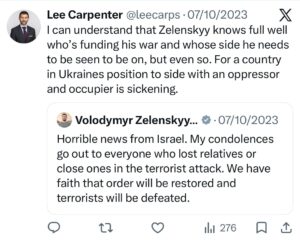
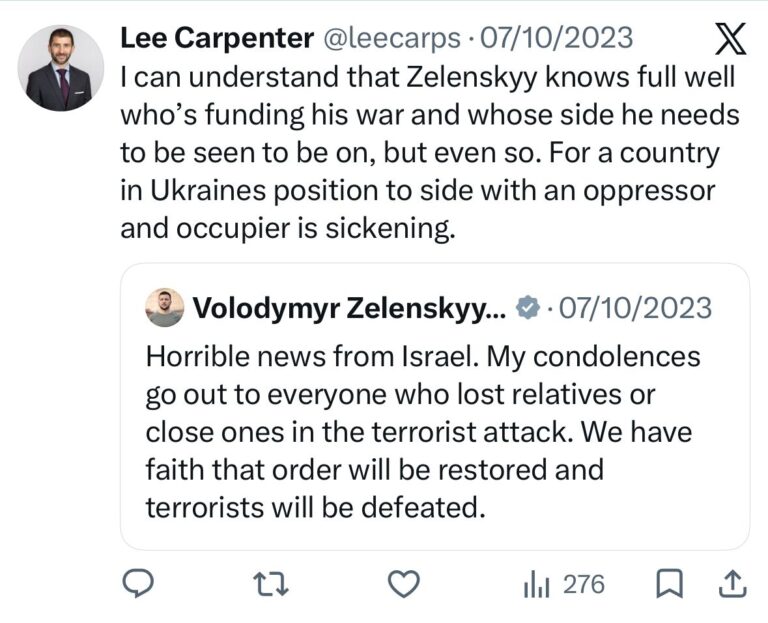
Having read the coverage, we became aware of a post on X (formerly Twitter) by Mr Carpenter on 7 October 2023, albeit there are other comments, as the reporting refers to, that have attracted public attention.
As the world was learning of the Hamas massacre in southern Israel, Ukrainian President Volodymyr Zelenskyy issued a message expressing solidarity with Israel and condolences for those murdered in the terrorist attacks.
Mr Carpenter responded not by condemning Hamas, expressing sympathy for the victims, or acknowledging the atrocities that had just taken place. Instead, he chose to describe Israel as an “oppressor and occupier”.
These remarks were made on the very day that more than 1,200 people were murdered, entire families slaughtered, women subjected to horrific sexual violence, and more than 250 people taken hostage in the worst massacre of Jews since the Holocaust.
Many people, Jewish and non-Jewish alike, will regard such a response as profoundly lacking in empathy, humanity and judgment.
Many Jews would find such remarks particularly troubling because they were made while the victims were still being identified and mourned. The comments were directed at Israel, yet they came at a moment when Jewish communities around the world were grieving the largest massacre of Jews since the Holocaust and were already experiencing a sharp rise in antisemitic hostility.
Among those murdered were peace activists, volunteers and residents of communities that had spent years building relationships and supporting coexistence initiatives with Palestinians. Their murder represented not only an attack on Israelis, but also on people who had devoted considerable effort to dialogue, reconciliation and the pursuit of a more peaceful future. The atrocities therefore struck not only at individuals, but also at the principle of coexistence itself, whilst reverberating throughout Jewish communities across the diaspora.
Whatever one’s views on the Israel-Palestinian conflict, the existence of political disagreement is not the point. Reasonable people can and do disagree about the policies of the Israeli Government. The concern arises from the timing and nature of the response to the mass murder of civilians, and whether there should be a minimum standard of decency when responding to such atrocities.
The overwhelming majority of Jews identify in some way with Israel and, in one form or another, subscribe to the principle of Zionism: the belief that the Jewish people have the right to self-determination in their historic homeland. For much of mainstream Judaism, Jewish identity and the connection to the Land of Israel are deeply intertwined and reflected throughout Jewish history, culture, tradition and religious practice.
For that reason, the events of 7 October were not experienced by many Jews as a distant geopolitical event. They were experienced as a profound communal trauma. It is therefore unsurprising that many Jews would regard remarks of this nature, made on the day of the Hamas massacre, as crossing a line from legitimate criticism of Israel into something more troubling. Many would regard such remarks as raising serious concerns about antisemitism.
It is notable that, despite the controversy surrounding Mr Carpenter’s remarks, no public statement has been brought to the National Jewish Assembly’s attention in which Mr Mézec has expressed concern about their timing or nature, acknowledged why many Jews found them troubling, or sought to distance himself from them.
These concerns arise in the context of Mr Mézec’s long-standing public association with the Jersey Palestine Solidarity Campaign and related pro-Palestinian activism.
There is, of course, nothing illegitimate about advocating for Palestinian rights. However, many Jews have become increasingly concerned by what they perceive to be a recurring pattern within parts of the Palestine solidarity movement, namely the application of markedly different standards of accountability to Israeli and Palestinian actors. Many are also troubled by what they see as a reluctance in some quarters to acknowledge, condemn or seriously engage with atrocities committed against Israelis.
One of the most troubling examples came in the immediate aftermath of 7 October itself. A Metropolitan Police Freedom of Information disclosure later revealed that organisers acting on behalf of the Palestine Solidarity Campaign notified police of plans for a national demonstration at approximately 12:50pm on 7 October 2023.
The significance of that episode lies in its timing. The notification was made while Hamas terrorists were still carrying out attacks inside Israel and before Israel had launched any substantial military response.
For many observers, this raised profound questions about priorities and judgment. While the largest massacre of Jews since the Holocaust was still unfolding, political mobilisation against Israel was already under way.
Nor are the comments highlighted above the only examples that have attracted public attention. Mr Carpenter’s wider public record on international affairs, including Israel, Zionism, Ukraine and Russia, has been the subject of public scrutiny and reporting. Some of that reporting has also raised questions concerning engagement with material that many Jews would regard as highly offensive, including comparisons involving Israel and Nazi Germany. Such comparisons are identified within the International Holocaust Remembrance Alliance (IHRA) Working Definition of Antisemitism as a recognised example of discourse that may be antisemitic in certain contexts. Members of the public are entitled to examine that record and reach their own conclusions.
None of this is about silencing criticism of Israel. Criticism of any government is entirely legitimate.
If similar remarks had been directed towards another ethnic, religious or national community in the immediate aftermath of a mass atrocity, would they have been regarded as acceptable?
Would the public response have been the same if the victims belonged to another ethnic, religious or national community?
These are not questions of affiliation or ideology.
They are questions about judgment, standards and public accountability.
The NJA believes they are questions worthy of public consideration.
NOTE:
The NJA encourages readers to examine the underlying material for themselves.
- Order-Order reporting concerning Reform Jersey and related issues
- Digging for Royals article discussing public statements and activity associated with Lee Carpenter
- Lee Carpenter’s public response to President Volodymyr Zelenskyy’s message of solidarity with Israel on 7 October 2023
- Screenshot archive of Mr Carpenter’s 7 October 2023 response to President Zelenskyy.
(Appended below for evidential purposes in the event that the original post is edited, restricted or removed.
Readers are encouraged to review the source material directly and reach their own conclusions.