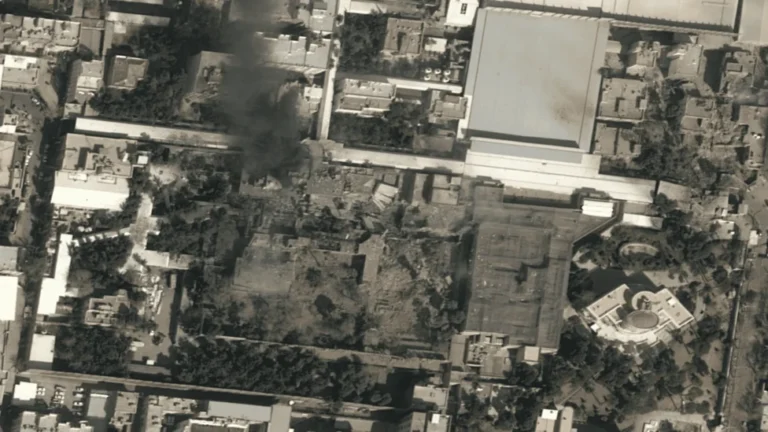
The We Believe Alliance stands firmly in support of the recent defensive and proportionate strikes carried out by the United States and Israel against strategic assets of the Iranian regime.
These actions targeted legitimate military and security infrastructure directly connected to the regime’s ability to project violence, sponsor terrorism and destabilise the region. They are not acts of aggression but necessary measures taken in response to sustained hostility, proxy warfare and explicit threats against Israel and Western interests, including the regime’s repeated calls for Israel’s destruction. The objective is clear: to degrade the operational capabilities of a regime that has openly vowed Israel’s elimination and has pursued that aim by funding, arming and directing militant actors across the Middle East.
We express deep concern for the safety of civilians across the region who now find themselves under threat. The people of Israel continue to endure rocket and drone attacks deliberately directed at civilian population centres. Communities in Gulf states such as the United Arab Emirates and Bahrain have also been placed in danger by Iranian threats and hostile activity directed toward civilian and commercial hubs. We also stand in solidarity with the people of Iran, a proud nation whose citizens have repeatedly shown courage in the face of repression. The Iranian people are not the regime. For decades they have suffered brutality, economic mismanagement, violent crackdowns on protest and the suffocation of basic freedoms.
The contrast in conduct is stark. While Israel and the United States have focused their operations on military and regime linked targets, the Iranian regime has predictably sought to strike civilian areas, targeting residential neighbourhoods in Israel and threatening civilian and commercial centres across the Gulf. This indiscriminate conduct reflects a longstanding strategy of terrorising populations rather than confronting military realities.
In a significant and unprecedented development, the death of Ayatollah Ali Khamenei during these strikes marks a profound turning point in Iran’s political trajectory. As the central figure of the Islamic Republic for more than three decades, his removal represents the most consequential rupture within the regime’s leadership since the 1979 revolution.
However, the death of a single leader does not in itself guarantee stability or meaningful change. What replaces the current ruling structure will be decisive. There remains a real risk that hardline elements within the security apparatus, particularly the Islamic Revolutionary Guard Corps, will attempt to consolidate power rather than allow genuine reform or political transition.
At this pivotal moment, the hope must be that the Iranian people, who have repeatedly demonstrated courage in the face of repression, are given the opportunity to shape a governing authority that reflects their aspirations for freedom, economic opportunity and engagement with the international community. Long term regional stability will depend not simply on the removal of individuals but on the emergence of leadership that abandons threats of destruction, ends support for proxy militancy and chooses constructive engagement with the wider world.
The path to regional stability lies not in appeasing Tehran’s ruling elite but in accountability and deterrence. In this context, the United Kingdom must confront the role of the Islamic Revolutionary Guard Corps (IRGC), the central instrument through which the Iranian regime exports extremism, funds proxy militias and orchestrates destabilisation across the region.
As part of our ongoing campaign to secure the proscription of the IRGC in the United Kingdom, we reiterate that the case for decisive action has never been clearer. The IRGC is not a conventional state institution. It functions as the regime’s principal vehicle for terrorism, coercion and the projection of ideological extremism far beyond Iran’s borders. Allowing such an organisation to operate without formal proscription leaves the United Kingdom exposed to networks that undermine national security, democratic institutions and social cohesion.
Proscribing the IRGC would send a clear signal that Britain will not tolerate state sponsored terror infrastructure operating with impunity within its financial and political systems. It would also align the United Kingdom more clearly with its allies in confronting the destabilising influence of the Iranian regime.
We stand with Israel’s right to defend itself, with the United States in confronting state sponsored extremism, and with the Iranian people in their aspiration for freedom from a regime that has brought repression, isolation and conflict upon them.