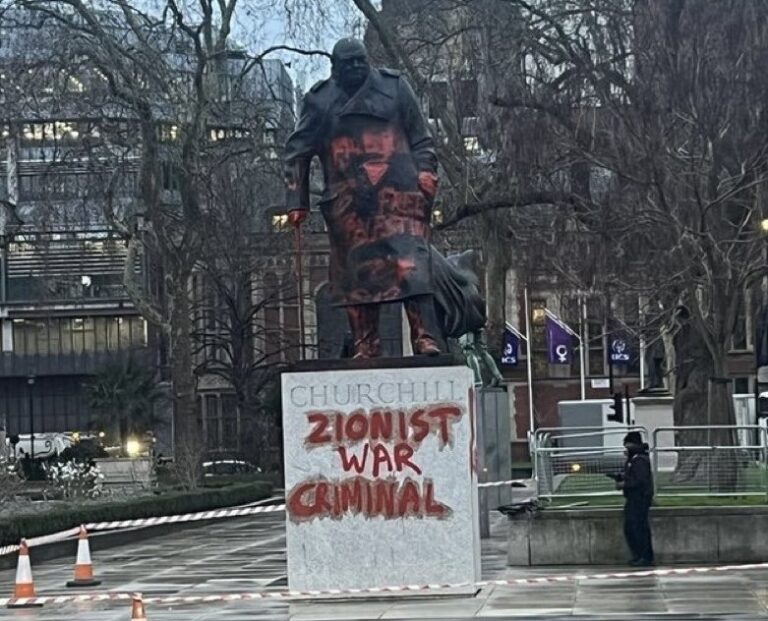
The We Believe Alliance, comprised of We Believe in Israel and the National Jewish Assembly, unequivocally condemns the disgraceful defacement of the statue of Winston Churchill in Parliament Square, London. This is not an isolated act of vandalism. It is the predictable manifestation of a climate in which hostility towards Jews and the Jewish national movement, Zionism, has been normalised, sanitised and politically indulged.
That this incident occurs on the morning after the Gorton and Denton victory for the Green Party, whose anti-Zionist positioning repeatedly strays into Antisemitic territory, is deeply concerning. When political actors legitimise rhetoric that delegitimises Jewish self-determination, they create the conditions in which such hatred finds expression in the public square.
For over two years now, since the Hamas massacres of October 7th, weekly pro-Palestine marches have taken place across our cities. These demonstrations have been marked not merely by political protest but by overt Antisemitism, including genocidal chants, the glorification of terror organisations, and the intimidation of Jewish communal spaces. Successive UK governments have failed to draw firm red lines. Recognition gestures, equivocal language, two tier policing, and an unwillingness to confront hate speech, including that which has been allowed to fester in certain religious settings, have contributed to an atmosphere of impunity. Defacements such as this are the end result of that failure.
The United Kingdom has formally adopted the International Holocaust Remembrance Alliance definition of Antisemitism. That definition explicitly includes as an example of Antisemitism “Denying the Jewish people their right to self determination, for example by claiming that the existence of a State of Israel is a racist endeavour.” The type of rhetoric increasingly normalised in anti-Zionist political motions falls squarely within that definition. One cannot adopt IHRA in principle while tolerating its breach in practice.
It is no coincidence that this rhetoric mirrors the ideological doctrine of the Islamic Revolutionary Guard Corps and movements aligned with the Muslim Brotherhood, whose foundational objective is the eradication of Israel and the rejection of Jewish sovereignty. These are organised ideological campaigns that export anti-Zionist Antisemitic extremism into Western democracies, shaping narratives and emboldening those who would deny Jewish self-determination. When British political discourse begins to echo these positions, even inadvertently, it reflects a deeper failure to confront the sources of the ideology itself.
This is precisely why the We Believe Alliance is campaigning for the proscription of both the IRGC and the Muslim Brotherhood in the United Kingdom. That campaign forms part of a broader effort to dismantle the ideological infrastructure that incubates Antisemitism and legitimises hostility towards the Jewish state under the veneer of activism.
Zionism is the national liberation movement of the Jewish people. For any other people, the aspiration to self-determination would be regarded as legitimate and unremarkable. Yet uniquely, Jewish nationhood has been recast as something malign. Those who most vociferously champion Palestinian self-determination frequently deny that same right to Jews. That double standard is not progressive politics. It is discrimination.
Britain’s history teaches us the cost of moral equivocation. Had it not been for the resolve of Winston Churchill, there would arguably be no free Britain as we know it today. Leadership requires clarity and courage in the face of hatred, not accommodation of it.
We call on political leaders across the spectrum to enforce the standards they claim to uphold, to act decisively against Antisemitism wherever it manifests, to confront the ideological forces that sustain it, and to reaffirm that Jewish identity, Jewish security and Jewish self-determination are non-negotiable within a democratic society. The We Believe Alliance will continue to fight unapologetically for Jewish values rooted in responsibility, justice and the sanctity of life, alongside the traditional British and Western democratic principles of liberty, the rule of law, national sovereignty and equal rights. These are not competing ideals but mutually reinforcing pillars of a free, confident and morally serious society.