The We Believe Alliance is a merger of the National Jewish Assembly and We Believe In Israel.
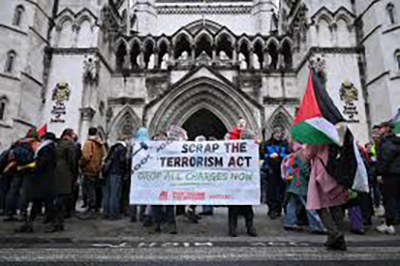
The High Court’s ruling on Palestine Action may be a legal determination, but it carries far wider implications for how Britain confronts organised movements that deliberately operate through confrontation, intimidation and calculated lawbreaking. When sustained campaigns of disruption and criminal damage are recast as legitimate “direct action”, the boundary between democratic protest and coercive militancy is steadily eroded. Over time, this normalisation of transgression weakens deterrence and invites escalation.
These tactics are not symbolic or theatrical. The systematic targeting of workplaces, workers and public spaces is designed to apply pressure through fear, disruption and economic harm. That logic of coercion is not incidental; it is one of the defining hallmarks of terrorism. Its impact is felt in real terms on community safety and social cohesion. For many Jews in Britain, these campaigns are not experienced as abstract activism about a distant conflict, but as localised hostility that intrudes into everyday life and corrodes their sense of security.
The Police Federation’s response to the acquittal of activists involved in a violent break in at an Elbit facility, during which a police officer was struck in the back with a sledgehammer, underlines the peril of sending mixed signals about violence. When serious assaults are minimised, rationalised or excused in the language of protest, it lowers the threshold for what is deemed acceptable and emboldens those who see confrontation and physical harm as legitimate political tools.
We Believe Alliance defends the right to peaceful protest as a cornerstone of a free society, but that right cannot extend to intimidation, violence or the deliberate targeting of people and institutions. While the Court’s finding is a legal one, it does not confer moral or democratic legitimacy on the methods employed. Violence and coercion are the hallmarks of terrorism, not of protest. Democracies survive by drawing clear lines and enforcing them consistently; when those lines blur, public order weakens and confidence in the authority of institutions erodes