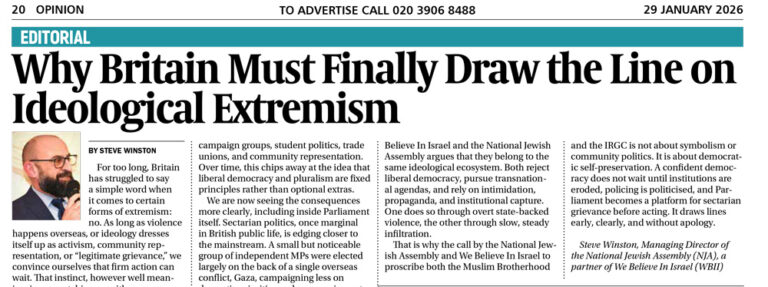
This op-ed by the NJA’s Managing Director Steve Winston was published in the Jewish Weekly’s January 29th 2026 edition.
For too long, Britain has struggled to say a simple word when it comes to certain forms of extremism: no. As long as violence happens overseas, or ideology dresses itself up as activism, community representation, or “legitimate grievance,” we convince ourselves that firm action can wait. That instinct, however well meaning, is now catching up with us.
Whether it is a hostile foreign power operating through intimidation and covert activity, or an Islamist movement quietly embedding itself into civil society, the pattern is the same. Britain’s openness is being exploited by ideological actors who do not share its democratic values and have no intention of playing by its rules. The cost of that hesitation is no longer theoretical. It is visible in our politics, our institutions, and our streets.
The Muslim Brotherhood sits squarely within this wider problem. Too Islamist to be entirely comfortable, yet often defended as non-violent and therefore tolerable, it has benefited for years from Britain’s reluctance to draw clear lines. That reluctance has come at a cost, not just for Britain’s Jewish community, but for the health of our democracy.
The government’s own 2015 review of the Muslim Brotherhood should have settled the issue long ago. It described the movement as secretive, hierarchical, and ideologically driven, operating through respectable front-facing bodies while concealing real loyalties. It also confirmed that senior Brotherhood figures have repeatedly used antisemitic language and defended violence carried out by Hamas, the Brotherhood’s Palestinian branch.
The threat posed by the Brotherhood is not that it will storm Parliament or plant bombs. Its strength lies in playing the long game: gradualism, entryism, and quietly shaping the environment around it. It seeks influence through charities, campaign groups, student politics, trade unions, and community representation. Over time, this chips away at the idea that liberal democracy and pluralism are fixed principles rather than optional extras.
We are now seeing the consequences more clearly, including inside Parliament itself. Sectarian politics, once marginal in British public life, is edging closer to the mainstream. A small but noticeable group of independent MPs were elected largely on the back of a single overseas conflict, Gaza, campaigning less on domestic priorities and more on imported grievance politics. Parliament should represent citizens as citizens, not become a proxy battleground for foreign conflicts.
The same pattern shows up elsewhere. The West Midlands Police decision to ban Israeli, Jewish and non-Jewish Maccabi Tel Aviv supporters from attending a football match was defended on public order grounds. Yet the political pressure surrounding it came overwhelmingly from activist voices whose politics revolve almost entirely around opposition to Israel. When that kind of pressure begins to shape policing decisions, it should concern everyone.
Education has not been immune either. The National Education Union’s relentless focus on the Israeli Palestinian conflict, often to the exclusion of other global crises, has turned too many classrooms and staff rooms into ideological battlegrounds. Repeated anti-Israel motions and campaigns have left Jewish teachers and pupils feeling isolated and targeted. Whatever one’s views on Middle East policy, a trade union should not act as a vehicle for one-sided political mobilisation that fuels division at home.
This is exactly the sort of environment in which ideological extremism thrives. Hatred of Israel becomes a unifying and disguising force, allowing antisemitism to be repackaged as politics and violence to be excused as “resistance.”
There is a clear parallel here with Iran’s Islamic Revolutionary Guard Corps. One is Sunni, the other Shia, but a recent Westminster policy briefing by We Believe In Israel and the National Jewish Assembly argues that they belong to the same ideological ecosystem. Both reject liberal democracy, pursue transnational agendas, and rely on intimidation, propaganda, and institutional capture. One does so through overt state-backed violence, the other through slow, steady infiltration.
That is why the call by the National Jewish Assembly and We Believe In Israel to proscribe both the Muslim Brotherhood and the IRGC is not about symbolism or community politics. It is about democratic self-preservation. A confident democracy does not wait until institutions are eroded, policing is politicised, and Parliament becomes a platform for sectarian grievance before acting. It draws lines early, clearly, and without apology.
To read in the Jewish Weekly, click here