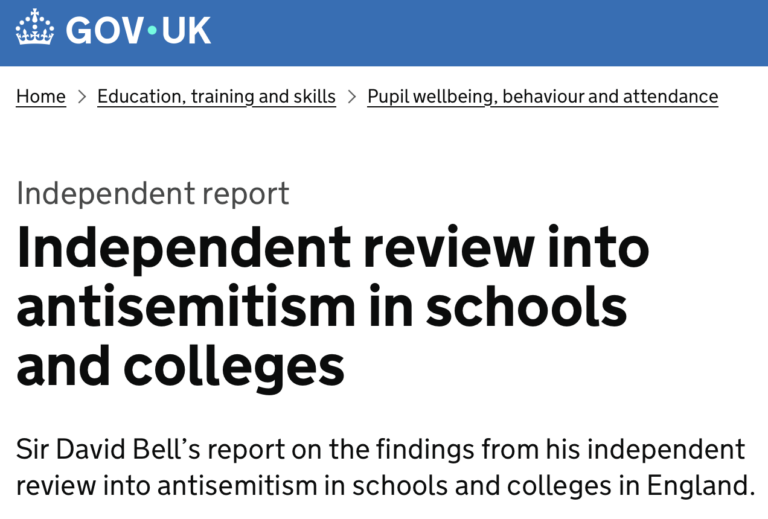
The National Jewish Assembly welcomes Sir David Bell’s independent review into antisemitism in schools and colleges in England, and the Government’s acceptance of its 27 recommendations.
The findings are deeply troubling, but sadly unsurprising. No Jewish child should have to endure intimidation, hostility or discrimination simply because of their identity, nor should Jewish teachers and staff feel isolated or unsupported in their own workplaces.
We particularly welcome the recommendations for stronger safeguarding, improved reporting of antisemitic incidents, better teacher training and greater recognition of the different ways antisemitism manifests itself.
However, recognising antisemitism is not enough if we fail to confront what helps fuel it.
In 2024, NJA, together with UK Lawyers for Israel (UKLFI), met with officials from the Department for Education to raise serious concerns about antisemitism in schools. These included the National Education Union’s (NEU) association with the Palestine Solidarity Campaign, the dissemination of misinformation and the danger of politically biased narratives entering classrooms.
Two years later, these concerns remain unresolved.
As UKLFI has highlighted in its response to the review, insufficient attention has been given to inaccurate and one-sided teaching materials concerning Israel, Zionism and Jewish history. Children must not be presented with contested political claims as established facts, nor should educational resources promote distorted accounts of the conflict while ignoring Jewish history, identity and legitimate perspectives.
Schools are places for education, not political indoctrination. Teachers have a responsibility to encourage critical thinking and present sensitive subjects accurately and impartially, rather than allowing personal political convictions or campaigning organisations to shape what children are taught.
We therefore urge the Government to go beyond the review’s recommendations by introducing meaningful scrutiny of external teaching materials and ensuring that political impartiality is upheld in practice, not merely acknowledged in principle.
The Government’s acceptance of these recommendations is a welcome first step. But Jewish pupils and their families need more than promises and policy documents. They need to know that schools will be safe, that antisemitism will be challenged wherever it appears, and that the education system itself will not become a vehicle for the prejudice it is supposed to prevent.
The true measure of this review will not be the recommendations accepted, but the changes delivered.