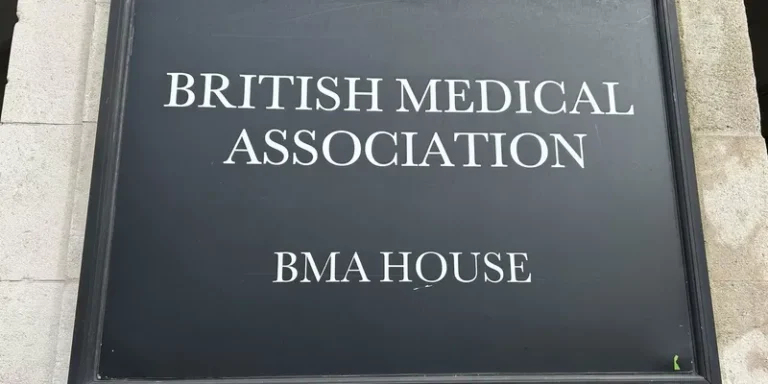
The National Jewish Assembly views the British Medical Association’s adoption of Motion 55 as official Association policy, opposing the mandatory adoption of the IHRA definition of antisemitism across the NHS, as a profound failure of leadership.
This was not simply a conference debate. By adopting Motion 55, the BMA established official Association policy and committed itself to pursuing that position.
This decision should give the BMA cause for profound reflection. Only weeks ago, Lord Mann’s independent review, commissioned following reports of persistent antisemitism, exclusion and discrimination experienced by Jewish NHS staff, found serious evidence of antisemitism, ostracism and exclusion affecting both Jewish staff and patients. The Government accepted the need for stronger action. Yet instead of helping to restore confidence, the BMA has chosen instead to concern itself with whether doctors might feel inhibited in making political interventions about Israel.
One might reasonably have expected a doctors’ union, confronted with evidence of antisemitism within the NHS, to ask how Jewish staff and patients could be better protected. Instead, the BMA has chosen to ask how those wishing to make political interventions about Israel might themselves be better protected.
That is a revealing inversion of priorities. Faced with evidence that Jewish staff and patients have felt isolated, intimidated and, in some cases, reluctant to seek care, the BMA has chosen to target one of the most widely used frameworks for recognising anti-Jewish prejudice. It has, in effect, looked at antisemitism in the NHS and concluded that the more pressing concern is the supposed plight of those who wish to demonise Israelis, Zionists or Jews without professional consequence.
The claim that the IHRA definition suppresses legitimate criticism of Israel is false. It does not prohibit criticism of Israel, or indeed of any other country. What it does do is help institutions distinguish between legitimate political expression and antisemitism, including when hostility towards Israel crosses the line into hostility towards Jews.
The irony is difficult to ignore. A definition expressly intended to help institutions recognise antisemitism has been portrayed as the problem, while antisemitism itself has been relegated to a secondary concern.
Doctors are entitled, in their private capacity, to hold and express political opinions. But private social media is not a professional safe harbour for abusive, discriminatory or extremist rhetoric. Recent cases have shown that when doctors use their personal platforms to post hostile or inflammatory material about Israelis, Zionists or Jews in ways that legitimately raise concerns about prejudice and impartiality, they can properly face professional consequences. The issue is not whether clinicians may hold views on the Middle East. It is whether they are free to indulge anti-Jewish hostility and then expect it to be dismissed as merely private speech.
The NHS is not a platform for ideological campaigning on the Middle East. Patients are entitled to trust that they will be treated with fairness, dignity and impartiality regardless of religion, ethnicity or nationality. Jewish and Israeli patients, and Jewish and Israeli staff, should not be made to feel that concern about antisemitism is a tiresome obstacle to be pushed aside whenever anti-Israel activism is at stake.
No doctor should imagine that conduct which would rightly trigger scrutiny if directed at any other minority group becomes acceptable simply because the target is Jewish, Israeli or associated with Israel.
Having now adopted this as official Association policy, the BMA owes Jewish doctors, nurses, other NHS staff and patients an explanation. How does weakening one of the principal frameworks used to recognise antisemitism make the NHS a safer place for those who have already reported experiencing it?
The NHS belongs to everyone. Its first duty is to inspire confidence that every patient will be treated with fairness, dignity and without prejudice. The BMA’s decision has made that task harder, not easier.
Click here to read our initial statement prior to the motion being adopted.